
Assessment of visual stress using the
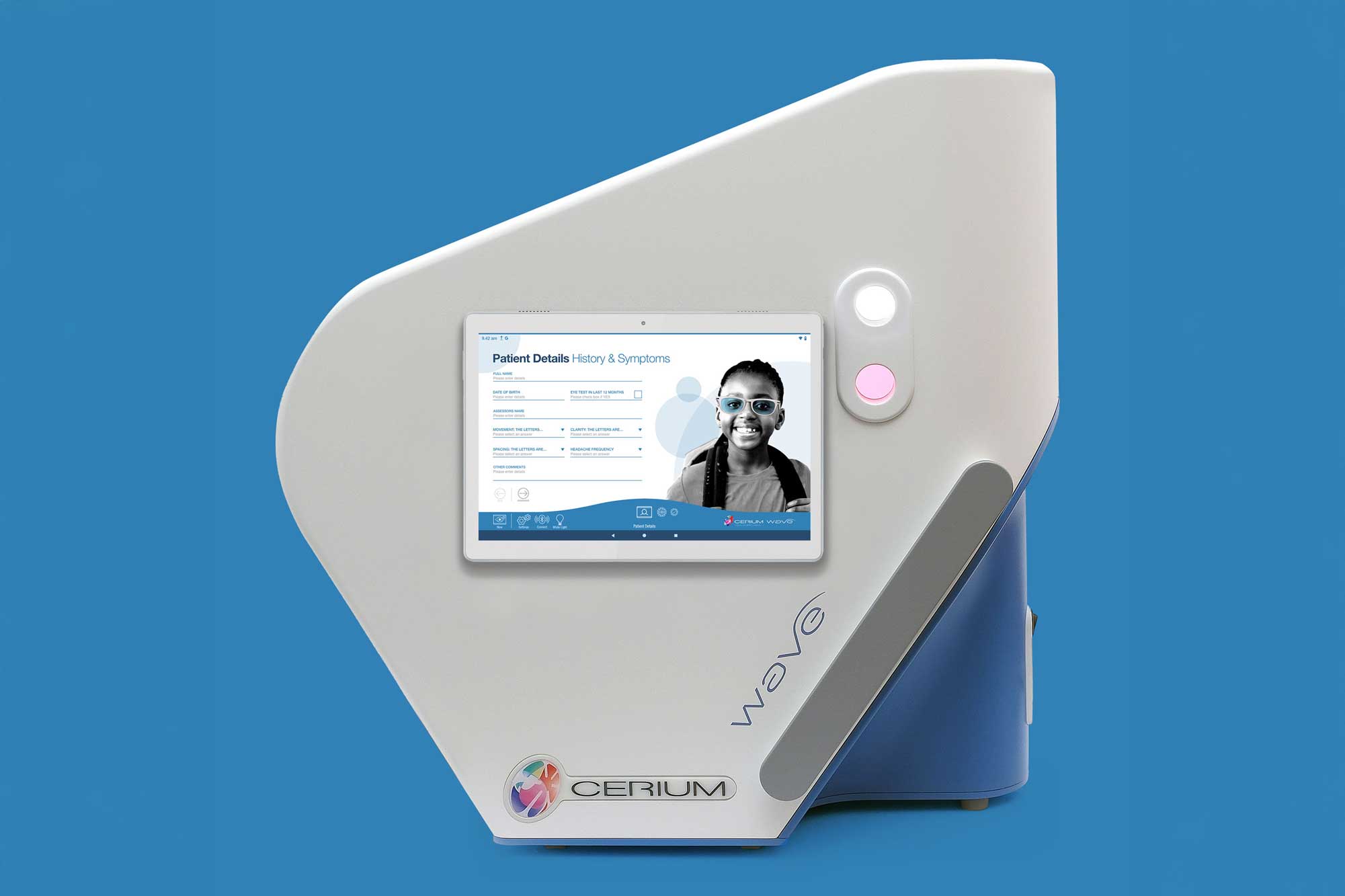
Cerium Intuitive Colorimeter
Some people experience discomfort, visual distortion, or fatigue when reading or viewing high-contrast patterns such as text on a white page or on digital screens.

This is often described as visual stress or pattern glare and may include symptoms such as words appearing to move, blur, shimmer, or cause headaches. These symptoms can occur even when standard eye tests are otherwise normal.
An intuitive colorimeter is a specialised clinical instrument used to assess whether precise coloured filters can reduce or even eliminate these symptoms.
During the assessment, you view text while the colorimeter systematically adjusts the colour of the background. The optometrist guides the process using your feedback, identifying whether specific colours make the text appear more stable, more comfortable, less bright, or easier to view.
There are thousands of colours in the visible spectrum. The optimal colour chosen is unique to each individual.
For some patients, a specific colour can significantly reduce visual discomfort. This colour can be prescribed in a pair of glasses to be used for specific tasks such as reading, screen use, or where there is bothersome lighting such as in a supermarket or shopping centre.
Some patients will benefit from wearing tinted glasses constantly, especially those migraine sufferers where their predominant trigger is glare.
It is important to note that colour assessment is not suitable for everyone. Tinted lenses are only recommended and prescribed if a clear benefit is demonstrated.

Signs and Symptoms of Tired Eyes and Visual Stress
- Movement and blurring of printed text
- Letters changing size or shape
- Seeing coloured halos in printed text
- Headaches, visual discomfort or tired eyes from reading
- Red, sore, watery and strained eyes
- Moving closer or further away from the book or computer screen
- Using your finger as a marker on a page of text
- Excessive glare from a computer screen, night driving, or when inside a shopping centre
- Skipping words or lines
- Frequently re-reading the same line
- Eye rubbing or blinking frequently while reading
- Poor comprehension while reading
- Falling asleep when reading or watching television
- Inability to wear sunglasses comfortably
- Problems going up or down escalators
- Problems with scrolling text on your phone
Ready to Find Out if Visual Stress
Is Affecting You?
If you or your child experience headaches, light sensitivity, words moving on the page, or difficulty sustaining reading, structured visual stress assessment can help determine whether colour
may improve comfort.
FAQs Visual Stress
Below are answers to common questions about visual stress syndrome, colourimetry testing, and tinted lenses for patients in Melton VIC.
– Frequent migraines, especially those triggered by glare or bright lights
– Epilepsy that is sensitive to flickering lights or visual patterns
– Dyslexia or reading difficulties
– Post-concussion syndrome or acquired brain injury with glare sensitivity, dizziness or blurred vision
– Eyelid twitching or light-related spasms
– Autism spectrum disorder (ASD), ADHD or neurodivergence with sensory sensitivity
– Children who avoid reading, fatigue quickly with schoolwork or struggle with text
– Neurological conditions such as Multiple Sclerosis (MS) or Parkinson’s disease.
Visual stress symptoms commonly include words moving on the page, headaches when reading, light sensitivity, visual discomfort, and poor concentration during close work.
– Vision clarity and whether glasses are required
– Eye health
– Eye coordination and focusing
This ensures symptoms are not caused by an undiagnosed vision or eye health issue before proceeding to colorimetry testing.
The test is:
– Gentle and non-invasive
– Tailored to the child’s age
– Not dependent on advanced reading ability
Assessment is often helpful when a child:
– Avoids reading – Complains of headaches
– Becomes tired quickly during schoolwork
– Loses their place easily
– Is falling behind academically despite normal eyesight
Early assessment can help determine whether visual stress is contributing to learning difficulties.
Many people with visual stress syndrome have:
– Normal vision
– Healthy eyes
– No need for glasses
Visual stress relates to how the brain processes visual information – not how clearly the eyes see. It is considered a sensory processing issue rather than an eyesight problem.
However, in some individuals, precision-tinted lenses may:
– Reduce visual discomfort
– Decrease sensory overload
– Improve reading endurance
– Increase focus and visual comfort
Research suggests that some children with autism or ADHD may experience improved visual tolerance and engagement with tasks when visual stress is reduced. Outcomes vary between individuals, and assessment determines suitability.
– In Parkinson’s disease, precision-tinted lenses may help improve visual comfort and certain movement
– visual symptoms in some patients.
– In Multiple Sclerosis, coloured lenses may improve clarity and reduce dizziness triggered by peripheral visual motion.
Results vary, and lenses are considered supportive management rather than a treatment for the underlying condition.
They can be incorporated into:
– Single vision lenses
– Multifocal lenses
– Occupational lenses
They may also be combined with anti-reflective coatings or photochromic (Transitions-style) lenses, depending on your visual needs.
This includes:
– Structured colour testing
– Assessment of visual comfort and clarity
– Determination of whether tinted lenses are appropriate
– Written recommendations
A comprehensive eye examination is performed prior to colour testing if one has not already been completed.
Book a Visual Stress Assessment
in Melton VIC
A comprehensive eye examination is performed before colour testing to rule out prescription or eye health issues. If no underlying eye condition explains your symptoms, colorimetry testing can determine whether precision-tinted lenses may improve your comfort.
Book your Visual Stress assessment in Melton VIC today.
Please complete our pre-assessment questionnaire before attending.
Complete the Visual Stress QuestionnaireClick here to book online today